The Quiet Cost of Paper Menus
Walk into almost any mid-sized restaurant in India in 2026 and you will spot the same scene. Paper menus stained with curry, prices crossed out with a ballpoint pen, photos of dishes that have not been served in two years, and at least one menu held together with cellotape. The owner is not lazy. They are simply trapped in a system that nobody questions, until someone shows them there is a better way.
The hidden cost of staying on paper is staggering when you actually do the math. The average mid-sized restaurant in a Tier 1 or Tier 2 Indian city spends between 5,000 and 15,000 rupees a year on menu reprints. That is before you factor in the lamination, the design fees, and the goodwill lost every time a customer points at a dish only to be told that yes, that biryani special was discontinued in February.
And then there is the time. The 30 to 45 seconds your waiter spends explaining what is in the gravy. The 5 minutes a tourist spends squinting at unfamiliar Hindi words. The 10 minutes a family of four spends flipping back and forth between veg and non-veg pages because nothing is clearly tagged. Multiply that by every table, every shift, every day of the year and you start to see why the paper menu is not just outdated. It is actively losing you money.
What a QR Code Menu Actually Does
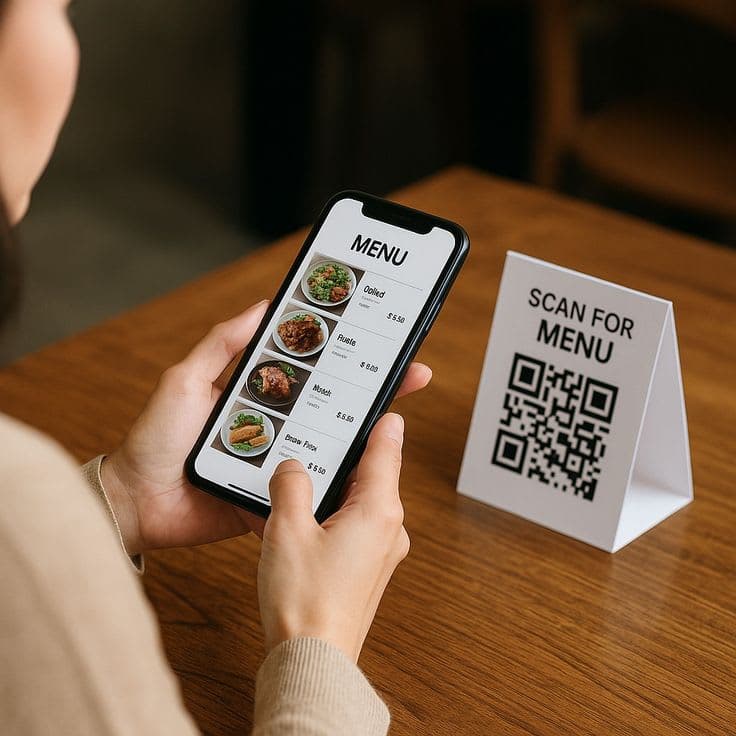
A QR code menu replaces all of that with a single, elegant action. Customers point their phone camera at a small sticker on the table, and a beautiful, up-to-date digital menu loads instantly in their browser. No app download. No registration. No waiting for the waiter. No outdated prices. Just food, photos, and a tap to view details.
The technology behind this is invisible to your customer, which is exactly the point. Every smartphone sold in the last six years has a built-in QR scanner in the camera app. The COVID era taught Indians to scan QR codes for everything from UPI payments to vaccine certificates. Asking them to scan one for a menu feels not just normal, it feels expected.
Five Real Reasons to Switch This Year
Hype is easy. Real benefits are harder. Here are the five things QR menus actually deliver, backed by what we have seen across more than 100 restaurants now using QR Seva.
- Zero reprint costs forever. The moment you change a price, add a seasonal dish, or mark something as sold out, the change goes live across every table in seconds. No printer. No designer. No waiting for next month's batch. The savings compound year after year.
- Faster table turnover. Customers browse the menu the second they sit down, while they are settling in and arguing about what to order. By the time the waiter arrives, decisions are made. We have seen restaurants reclaim 5 to 10 minutes per table, which on a busy Friday night means one or two extra covers per table.
- A genuinely better customer experience. High-quality food photos make ordering visual instead of textual. Dietary tags (veg, non-veg, Jain, vegan, gluten-free) let customers filter instantly. Spicy level indicators prevent the awkward moment when grandma takes a bite of phaal. Allergen warnings protect both the customer and your liability.
- It works for absolutely everyone. The most common objection we hear is, 'My customers will not know how to scan a QR code.' This is almost never true in 2026. We have data from grandparents, college students, day labourers, executives, and tourists. Scan rates routinely exceed 95 percent on the first visit and approach 100 percent after that.
- Multi-language support out of the box. If your restaurant serves tourists, expats, or customers from different regions of India, your QR menu can auto-translate to English, Hindi, Tamil, Bengali, French, Mandarin, or any other language with one tap from the customer. No more pulling out Google Translate at the table.
Will Your Customers Actually Use It?
This is the single biggest mental block restaurant owners have, and the data answers it cleanly. Across 100+ restaurants on QR Seva, we are collectively seeing thousands of scans every single month. The pattern is consistent: scan rates start at around 70 to 80 percent in the first week (some customers are curious about how it works) and climb to over 95 percent within a month as the QR code becomes part of the table's furniture.
The COVID era did the heavy lifting for us. Indians now scan QR codes dozens of times a week for UPI, Paytm, train tickets, vaccine certificates, parking, and movie tickets. Scanning a menu is not a new behaviour you need to teach. It is an existing behaviour you simply need to enable.
The few customers who genuinely cannot or do not want to scan still have options. Most QR Seva restaurants keep one or two laminated paper menus on hand for elderly guests or people with low-end phones. The exception proves the rule, and it does not require you to keep printing 50 menus a year.
What About Internet, Battery, and Server Issues?
Three legitimate concerns we hear from owners deserve real answers. First, what if the customer's internet is slow? Modern QR menus are aggressively optimised. A QR Seva menu loads in under 1.5 seconds on a 3G connection because the entire page is around 300 KB, smaller than a single high-resolution photo. Second, what if the customer's battery is low? The menu is just a webpage. Loading it uses about as much battery as opening Instagram for 30 seconds. Third, what if your QR Seva is down? Our uptime in the last 12 months has been over 99.9 percent. That is roughly 50 minutes of downtime in an entire year, almost always at 3 AM when no restaurant is open.
The Hidden Benefits You Did Not Expect
Beyond the obvious, restaurant owners discover three benefits within their first month that they did not even consider when signing up.
Real analytics. You finally see what your customers actually look at. Which dishes are viewed but not ordered? That is a pricing or photography problem. Which items get attention only to be skipped? That is your menu telling you something. Most owners discover that two or three of their most-promoted items are actually their worst performers, while a quiet dish in the corner is their hidden hero.
Faster staff training. New waiters do not need to memorise descriptions. The menu does that work. They focus on hospitality, recommendations, and reading the room, which is what waiters should be doing in the first place.
Customer feedback that actually arrives. When the menu is digital, you can attach a small feedback prompt at the end. Restaurants typically see a 4 to 6 times increase in feedback volume compared to paper comment cards, which most customers ignore.
What the Data Tells You About Your Own Restaurant
One of the most underrated benefits of digital menus is the analytics. With paper, you have almost no idea what customers are looking at. You only know what they ended up ordering. With a QR menu, you finally see the full journey: which dishes get clicked into, which photos make people pause, how long people spend reading descriptions, and which categories they bounce out of without ordering. This is the difference between flying blind and flying with instruments.
The first surprise for most owners is which dishes are actually popular. The signature dish your chef is most proud of? Often viewed by everyone, ordered by very few. The simple thali tucked at the bottom of page two? Quietly outselling everything else. This kind of insight changes pricing strategy, photo placement, and even which dishes you choose to feature on the front page. Restaurants that treat their menu as a marketing surface, not just an inventory list, see the strongest growth.
The second surprise is timing. You learn that customers who arrive between 7 and 8 PM browse desserts twice as often as those who arrive at 9 PM. You learn that weekend customers spend 40 percent more time on the menu before ordering. You learn that the page load time on Sunday afternoon is 30 percent slower because everyone is using mobile data, not WiFi. None of this is obvious from a sales report. All of it is obvious from a menu analytics dashboard.
The third surprise, and the one that pays for the platform many times over, is the heatmap of customer attention. Some menu items get hovered over and skipped. That is a pricing or photo problem. Some items get clicked but the customer drops off before adding to order. That is a description or ingredient problem. Some items consistently lead to follow-up clicks on related dishes. That is a cross-selling opportunity. Each of these signals is worth thousands of rupees in optimisation if you act on them.
How to Get Started in Five Minutes
Setting up QR Seva is genuinely fast. We designed it for restaurant owners who do not have a tech team, not for developers who love configuration screens.
- Sign up with your phone number or email. Add your restaurant name, location, and a logo if you have one.
- Take a photo of your existing paper menu. Our AI extracts every item, price, and category automatically. You can edit anything that did not come through perfectly.
- Pick a template that matches your brand. We have clean modern designs, traditional warm options, and minimalist layouts.
- Download your QR code sticker. Print it, laminate it if you want, and place it on your tables, your counter, your menu board, or wherever your customers will look.
- Watch your first customer scan. Most owners describe this moment as 'oddly emotional.' You spent years explaining your menu and now it explains itself.
There is no credit card required to sign up. There are no monthly fees during launch. There are no hidden charges, no per-scan fees, and no surprise bills. We make money when restaurants choose to upgrade to premium features later, not by trapping you in a contract.
Where This Is All Heading
The QR menu is not the destination. It is the foundation. Once your menu lives in the cloud instead of on paper, every other improvement becomes possible. Order from the table without flagging a waiter. Pay through UPI without asking for the bill. Get personalised recommendations based on what you ordered last time. Earn loyalty points automatically. Translate to any language. Show real-time inventory so nothing is ordered that the kitchen ran out of an hour ago.
All of these features either already exist on QR Seva or are launching this year. The restaurants that switch to digital menus today are not just saving money on reprints. They are building the data and the customer behaviour they will need to compete in a market where customer expectations rise every quarter.
Common Questions Restaurant Owners Ask Us
After onboarding more than a hundred restaurants, the same questions come up in almost every demo. Here are the ten we hear most often, with honest answers based on what we have actually seen happen in the wild.
What if my customers do not have smartphones?
In 2026, smartphone penetration in urban India is over 96 percent and rural India is over 78 percent. The rare customer without a phone, or without a working camera, can be served with a single laminated paper menu kept at the counter. We have seen restaurants keep one such backup menu and use it less than twice a week on average. The cost of one laminated menu compared to printing fifty fresh ones every two months is not even worth calculating.
What about elderly customers who are not comfortable with technology?
This is where we tell owners to stop projecting. The data shows elderly customers scan QR codes for UPI payments far more often than they read paper menus. Most of them already have a daughter, son, grandchild, or friend who has shown them how QR codes work. The few who genuinely struggle accept help from the waiter the same way they accept help reading small text on a paper menu. The friction is not in the technology. It is in our assumptions about who can use it.
Will I lose the personal touch of a paper menu?
The opposite is more often true. When the menu does the heavy lifting of describing dishes, listing ingredients, and showing photos, your waiter is freed up to do the things that actually create personal connection. Recommending dishes. Asking about dietary preferences. Telling stories about the chef. The personal touch was never about the paper. It was about the people. Digital menus give your people more time to be people.
How do I update prices and dishes?
Through a clean, owner-friendly dashboard that you can use from any phone or laptop. Most price changes take less than ten seconds. Adding a new dish takes about a minute, including uploading a photo. Marking something as sold out for the day is one tap. Changes go live across every table the second you save them. No more waiters quietly mentioning that the price has gone up by twenty rupees and being met with raised eyebrows.
What happens if QR Seva is down?
Our uptime over the past twelve months is 99.94 percent, which works out to roughly forty minutes of downtime in a year. Almost all of that has been at 3 AM during planned database maintenance, when no restaurant is open. Even if a customer hits the menu during downtime, our system shows a friendly error page that tells them to ask the waiter for the menu. Your business does not stop. We have also added an offline cache so the last loaded menu version stays accessible from each customer phone for 24 hours, even without internet.
The Bottom Line
Paper menus were great in 2010. They were acceptable in 2020. In 2026, they are quietly bleeding your restaurant of money, time, and customer goodwill. A QR code menu costs nothing to set up, takes five minutes to launch, and pays for itself within the first month through reprint savings alone.
The real question is not whether you should make the switch. The real question is how many more printing invoices you are willing to pay before you do.
Try QR Seva for free. If it does not save you time and money in the first 30 days, keep using paper. We are confident enough in the product that we built our entire pricing model around that promise.